Showing posts with label Gencove. Show all posts

Saturday, February 27, 2021

Why I think the basepaws "Breed Group" should be called an "Ancestry Cluster" (with abstract cluster names)

Part #1: Short Summary:

In the basepaws Facebook group, there are some noticeable issues with results for purebred cats that are not already part of the reference set (as I understand it).  To be fair, I have seen at least one report that was a good result (matching the known breed in a new test cat), but I think independent test datasets tend to be discordant with known purebred cats more often than they are concordant with new purebred cats (in the small fraction of customers where that can be tested).  Also, the majority of cats are mixed breed "Polycats" where there probably shouldn't be any close purebred relatives, and I think the results more-or-less match that expectation (if interpreted correctly, and I have found explaining precisely what I think is "correct" interpretation to be bit of a challenge).

Again, to be fair, basepaws does say "Disclaimer: The Basepaws Breed Index is not a breed test".  However, I think there is still some noticeable confusion.  So, regardless of whether my suggestion is helpful, I think it is safe to say you should not be using basepaws to confirm your cat's breed or disprove your cat's breed, and you may not have closely related cats for the "breed" with the highest estimated breed fraction in chromosome painting (which, in the wording of the current reports, may be "Breed Group" instead of "Breed Index" - either way, this is what you receive when you order the Breed + Health DNA Test, and you can see some type of chromosome painting in the various reports for Bastu).

After having several very helpful discussions, I thought of a possible suggestion that I thought might help: perhaps use a more abstract name for an ancestry group / cluster to make clear that you shouldn't use what is being provided to define breeds.

I think the best example may be the broad "Eastern" ancestry group, which is already in the reports (as a broader category) as well in previous literature on cat genomics.

If calculated accurately, I would expect Siamese cats will tend to have a higher estimate of Eastern contribution (at least for the "Traditional" Siamese cats, as I understand it).  However, I think the Colorpoint Restriction mutation might be what owners might want to check for cats with the characteristic hair color pattern.  For example, you might have to dig around a bit in the comments for this video but I believe "Lynx Point" cats can be defined from 2 markers (the Colorpoint Restriction variants, and Agouti variants for the tabby pattern).

Nevertheless, my point is that I believe giving the ancestry group the "Eastern" name adds a layer of conceptually separation than the "Siamese" (or related) breeds.

So, if technical problems are minimal, then I think this might reduce confusion for purebred cat owners (as well as minimize miscommunication from misunderstanding).  It might also reduce interest, but I would rather plan to have fewer customers than have more customers whose satisfaction might decrease over time.

It might also be worth noting that I believe most imputed genotypes are phenotypically neutral, meaning that they do not cause the traits that are used to define the breeds (although relatedness does define the breed, once it becomes established).

There are some additional details that I will discuss below, but I hope this can help for discussions (instead of me posting several comments, which may or may not be appreciated by all basepaws customers).  I also have a "Change Log" since I hope that I can update this based upon feedback, in order to try and be able to explain my point as precisely as possible.

Part #2: Intermediate-Level Details:

I have a separate blog post describing results (from multiple organizations / companies) for my cat Bastu.

However, I will copy / repeat some points below.  Some hopefully complement the main point for the "Short Summary," but some of these are separate points.

First, I think seeing 3 technical replicates for my 1 cat may be helpful in giving a sense of confidence in the results:

"Confident" Threshold


"Possible" Threshold


All 3 reports above were re-processed at the same time (for an update), but they were sequenced in different batches.

If you look at the broad ancestry groups, then there is some noticeable consistency with the technical replicates.  A mostly "Western" contribution for Bastu also makes sense, and that is also consistent with the her Ancestry Test from UC-Davis.

Please also note that the 1st 2 samples (left and middle) are low coverage Whole Genome Sequencing (lcWGS) and the report on the right is "regular" coverage sequencing (~15x).

For example, initiatively, I would not expect Bastu to be related to any Exotic breeds.  So, in addition to the general issue that accurately genotyped variation can exist before breed creation and confound the results, you can see the "Exotic" contributions go away in the higher/regular coverage sequencing data.

The main reason that I purchased the "Whole Genome Sequencing" kit was that I would get access to the raw data.  Since the price is different now, I will include the analysis part of this file below (without the header listing the original price):

Again, noticed the relatively higher Western contribution is also consistent with my re-analysis.
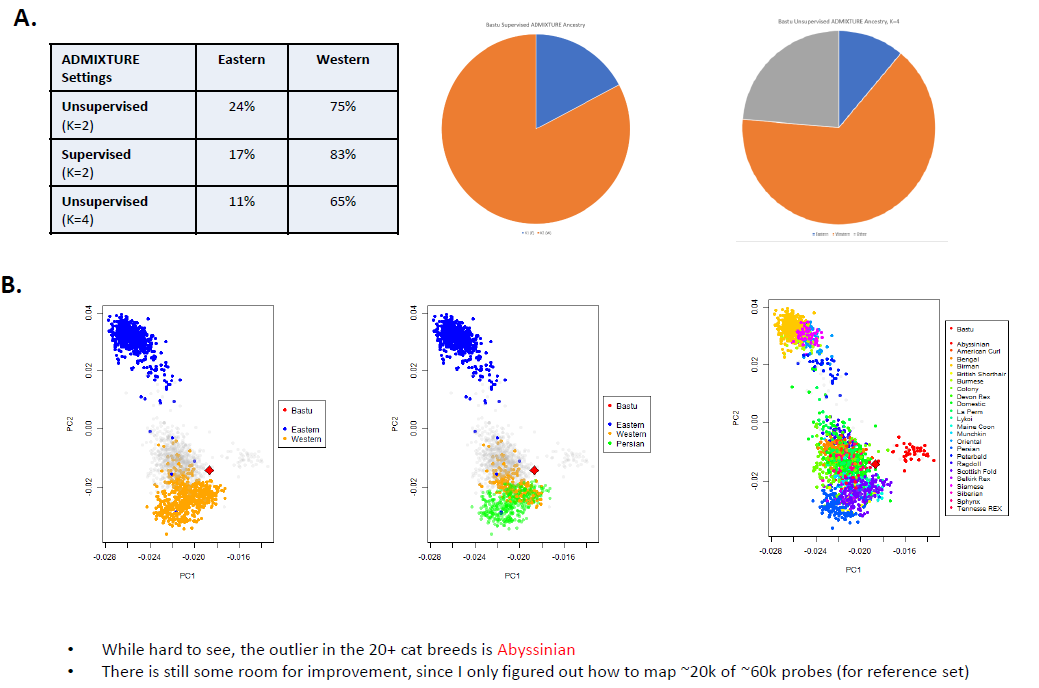


While I want to make clear that the PCA plots (the dots in the bottom part of the image, which I tried to describe as part "B") come from a relatively limited number of SNPs (from public cat SNP chips).  So, I don't know what the spread looks like if you could look like if you could see the individual points in the basepaws data, but I think plotting a centroid may not be the best way to represent the data (if that is what was done here).

There has also been at least 1 sample mix-up (for a different customer).  However, basepaws offered a free re-test which showed much better results.  So, that can happen, but I am guessing that is rare (and the more common issue is what I am describing in this blog post).  For example, when you look at my 2 lcWGS replicates (equivalent to a paid re-test), one is not really better than the other.  There is just a certain about of noise and limits to the methods (at least currently).

Part #3: Advanced Details:

With my ~15x cat genome data (along with my human data), I tested running imputation of down-sampled reads, which you can see here.  I am also plotting that below:
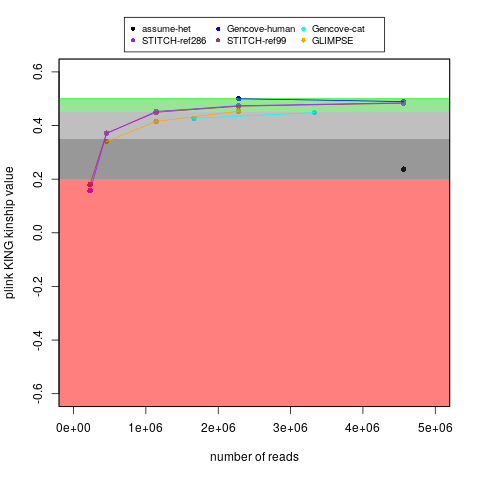


For reference, I don't have the raw lcWGS FASTQ data, but earlier versions of reports said that technical replicate #1 had 3,488,515 fragments and technical replicate #2 had 2,712,098 fragments.  For comparison, my regular coverage WGS sample had 166,490,724 paired-end reads (I think comparable to the "fragments" in those reports).

Because of the fragments smaller than the read length, my "regular" coverage WGS was closer to 15x than 20x.  I also don't know how many fragments are for lcWGS versus Amplicon-Seq in the "Breed + Health" results.  Nevertheless, I think the lcWGS "fragments" in those earlier reports roughly match an expectation of being 0.1x to 0.5x.

My main goal in the above plot was to test self identification.  With the same number of reads, the Gencove cat imputation worked a little worse for my cat's sample than my human sample (for either Gencove or open-source options for humans), but I don't think that is surprising because I think the human variation is better understood.  Nevertheless, if you follow the Gencove-cat trajectory, then I think there might be some benefits to having ~2x the fragment count (even though I would probably still not consider that to be equivalent to genotypes without imputation).  That said, to be fair, I don't know if some things (like broad ancestry groups) might be detectable with less precision than being able to self identify your own (cat's) sample.  Also, if a relative finder function is added, then Bastu's 2 lcWGS technical replicates can act as a positive control (to gauge how important this measure really was).

Likewise, I believe there is at least the Martin et al. 2021 paper emphasizing a noticeable advantage to using 4-6x WGS (over 0.5x WGS).  For example, there is a noticeable difference for the 0.5x results in Figure 4A (and as well as Table S4 and Table S5).  That is for certain populations, but it seems like that may match what I am seeing as well?

Perhaps most importantly, to give some more examples of selected problems on the human side, you can also see issues with the human lcWGS imputation here at the level of individual genotypes, which I think may be why Nebula now only provides regular/high coverage sequencing for customers.

basepaws uses Amplicon-Seq (not the lcWGS) for the health markers, so I believe those should be thought of as independent results (and the technical replicate discordance is not necessarily predictive of the concordance for the health markers).

My understanding is that basepaws is planning on adding Amplicon-Seq for trait markers in the future.  I think this will be added to the existing report for the "regular" coverage sequencing data.  However, customers will need to keep in mind this can't (or at least shouldn't) be added from the lcWGS.  My understanding is that the additional cost to add those extra Amplicon-Seq markers to previous reports will be minimal, but I think that is worth making clear new libraries need to be prepared to return those results.

It might not be the most important point, but I wanted to acknowledge that I believe what basepaws is doing with the chromosome painting is better than produced got for Bastu's sample with RFMix (which you can see here, for example, if you scroll towards the middle of the post).  However, I thought that was sufficiently far from being a reasonable result that I did not include that in my mini-report of re-analysis that I showed above.  I am also expressing similar concerns for the technical replicates above.

So, in the immediate future, I am not sure if doing something like the ADMIXTURE analysis used for the table and pie charts might help with giving robust results for those broad ancestry groups (which I think should also work with closely related cats, if you used something like plink kinship).  If there were any issued with defining relatedness with the chromosome painting results, then I think that that should be OK with enough reads for 1 genome-wide estimate (and I would rather have a close cat relative finder than a breed index/group that might cause confusion and may not be great at identifying breeds in new test samples, like what I have seen in the Facebook discussion group).  However, either way, that is the explanation for what I presented in my "mini-report" from re-analysis of raw "regular" coverage sequencing data.

Part #4: Acknowledgements:

I can't thank the other basepaws customers enough for their discussions, which have helped me sort through my thoughts.  I also hope that can continue in the future!

The basepaws staff has also provided responses to all of my e-mails.  For example, I think that is how I know the Breed Index/Group (which shouldn't be used to categorize purebred cats) comes from lcWGS and the health markers come from Amplicon-Seq (also verified here).  So, thank you for your helpful feedback, as well as encouraging a community were such discussion can take place!

P.S. I have some on-going notes about known traits (not currently in the basepaws report), but I would be happy to hear more.  This includes things like long hair.

In general, I tend to provide things like links to informational details from the UC-Davis VGL, but I am encouraging you to us the links on the informational page to purchase those separate tests.  For example, I purchased the UC-Davis "Cat Ancestry" panel that includes some trait markers as well the Optimal Selection panel (also mentioned in the earlier blog post).

If you are a breeder, I think part of the goal of Optimal Selection is to identify mating pairs with the maximal possible diversity within the breed.

Maybe it is otherwise a little off-topic, but I mention this because I think people purchasing the Breed + Health kit might in fact be interested in understanding some of the traits that they see in thier cat.

P.P.S. If a relative finder was added and both parents were in the basepaws database, then that would in fact be relevant for confirming that a cat is purebred (as long as there were no methodological issues, or especially low read coverage).  However, that is not currently offered from basepaws, so that is why I am saying that the current breed measures cannot be used to determine your cat's breed (as also said in the disclaimer from basepaws).

Change Log:

2/27/2021 - public post

2/28/2021 - minor changes (including switching wording from "Breed Index" to "Breed Group")

3/6/2021 - add notes for some other common questions and caveats + minor change

3/15/2021 - add lcWGS fragment counts (and linked image)

3/26/2021 - add note to make clear that all 3 reports were re-processed at the same time + add link to Martin et al. 2021 lcWGS paper

3/28/2021 - add extra details / minor re-organization; correct misunderstanding of table

4/18/2021 - add sentence about basepaws sample mix-up

11/21/2021 - add note about 2 markers defining "Lynx Point".

Wednesday, May 6, 2020

Opinions Related to Gencove Pre-Print Comment


Because a pre-print comment is somewhat formal, I thought that I should separate my opinions from the main feedback.

So, I decided to put those in a blog post.  You can see my pre-print review/comment here, and these are the extra comments:

General Notes / Warnings (Completely Removed from Comment):

My Nebula lcWGS results were OK for some things (like relatedness and broad ancestry), but I found the Gencove accuracy to be unacceptable for specific variants (for myself).

While Nebula has changed to only provide higher coverage sequencing, I previously submitted an FDA MedWatch report for my own data (for the lcWGS Gencove results).

To be fair, there are also general limits to the utility of most of the Polygenic Risk Scores that I was able to test with my own data (with some informal notes in this blog post).  So, while true, mentioning that I still had concerns about the percentiles that I saw from Nebula (even with the higher coverage sequencing data) may be less relevant.

Similarly, while I want to encourage other customers to report anything they find to MedWatch (and/or PatientsLikeMe, etc), I also want to acknowledge my own limitations that this general warning is more about specific issues that I found for myself.  For example, it may help to have an independent analysis with larger sample sizes to gauge my general PRS concerns and/or be more specific in terms of which specific PRS do or do not have clinical utility with sufficient predictive power for the disease association.

Specific Comment #2) I think my own result might match the imputed correlation that is described (in terms of having ~90% accuracy).  However, I would say that is unacceptable for making clinical decisions, especially since more accurate genotypes can be defined.  It is important to be transparent and not over-estimate accuracy, so I think that part is good.  I also realize that something unacceptable for individual variants can be acceptable for other applications.  However, I think something about limits should be mentioned for the general audience, even if they really apply to the same Polygenic Risk Scores in higher coverage sequencing data.

I am not sure if this matters for this particular project, but I have found that it is not unusual to learn about something that may contradict an original funding goal.  I have certainly noticed that it can take me a while to realize I need to question some original assumptions, but sharing those experiences is extremely valuable to the scientific community (if the conclusions then shift to helping others avoid similar mistakes).  I also realize prior assumptions can be hard overlook in comments/reviews as well, and there is definitely more that I can learn.  Given that you have a pre-print and there is a lot of details in supplemental information and external files, I think that is a good sign.

Specific Comment #3) In the future, I hope that this is also the sort of thing that precisionFDA, All of Us, etc. can help with.  In fact, as an individual opinion, this makes we wonder if the SBIR funding mechanism might be able to help with directly providing generics through non-profits (especially for genomics diagnostics).  However, I don’t think that means SBIR for-profit funding would have to be completely ended to preferentially fund non-profits, and I realize that probably can’t affect this particular paper.

If the Gencove code isn’t public, then I am not sure how you could show others could reproduce a freeze of the code before testing application to new samples.  Nevertheless, I applaud that you provided some code for the publication.

Specific Comment #4) There may be a way to revise the current manuscript without adding the independent (public) test data and/or the open-source alternatives.  For example, I don’t think you need additional results for your effective coverage section, but I am more interested in the concordance measures.  If the Gencove / STITCH / GLIMPSE / IMPUTE results are similar in terms of technical replicate concordance (for the same 1000 Genomes samples), then I think that you could skip what is described for specific comment 3) for this paper.

I also noticed that the competing interests statement was in the past tense for the present employees (as I understand it).

Summary: I think the utility for lcWGS to cause additional genomic data types to be considered identifiable information is important (which I have in a different blog post).


Change Log:

5/6/2020 - public post

Sunday, March 8, 2020

Testing Limits of Self-Identification / Relatedness using Genomic FASTQ Files

Color asked me sign a HIPAA release in order to get access to raw genomic data, which included a FASTQ file with ~15,000 reads.  So, I thought it might be useful to get an idea about how few reads (from random low-coverage Whole Genome Sequencing) can be used to identify myself.

To be clear, I think most rules are meant to take possible future advances into consideration.  So, just because I can't identify myself, doesn't mean somebody else can't identify me with fewer reads (with current of future methods).  Nevertheless, if I can identify myself, then I think that there is a good chance others could probably identify themselves with a similar number of reads and/or variants (and possibly fewer reads/variants).

Down-Sampling 1000 Genomes Omni SNP Chip Data

I compared relatedness estimates for myself with the following genotypes:  1) Veritas WGS, 2) 23andMe SNP chip, 3) Genes for Good SNP chip, and 4) Nebula lcWGS (along with the matching positions from the 1000 Genomes Omni SNP chip).

Perhaps more importantly, I also show kinship/relationship estimates (from plink) for 1000 Genomes samples for parent-to-child relationships as well as more distant relationships:


As you can see, there is a bit more variability in the parent-to-child estimates with a few thousand variants.  The self-identification estimates (among pairs of my 4 samples) were always greater than 0.45, but there is noticeable overlap in the kinship estimates for 1000 Genomes parent-to-child and more distant relatives when you drop down to only using 19 variants.

So, making sure you didn't get false positives for close relationships may be important, particularly with smaller numbers of variants.  If you have SNP chip or regular Whole Genome Sequencing data, then identifying yourself would also be easier than having 2 low-coverage Whole Genome Sequencing datasets.

However, if I can get 1000s (or perhaps even 100s) of variant calls, I am currently most interested in how accurate those calls can be.

Gencove and STITCH Imputed Self-Identification

I have earlier posts showing that the Gencove imputed variants from Nebula were not acceptable for individual variant calls, but I think they provided reasonable broad ancestry and relatedness results.  To be fair, I don't believe Nebula is currently providing low coverage Whole Genome Sequencing results anymore, opting for much higher coverage (like regular Whole Genome Sequencing).  However, Color provided me with considerably fewer lcWGS reads than Nebula (and Color also has a pre-print about lcWGS Polygenic Risk Scores that I was concerned about).

So, I was interested in testing what imputed variants I could get if I uploaded FASTQ files for Gencove analysis myself (as well as an open-source option called STITCH).


There is also more information about running STITCH (as well as more statistics for Gencove variant concordance) within this subfolder (and this subfolder/README) on the human GitHub page.  Essentially, the performance of the human lcWGS looks good at 0.1x (if not better than the earlier Gencove genotypes that were provided to me from Nebula), but there is a drop in performance with the cat lcWGS.

I ran the STITCH analysis on a local computer, so the run-time was longer than Gencove (between 1 day and 1 week, depending upon the number of reference samples - hence, I would start with running STITCH with ~99 reference samples in the future).  However, if you were willing to pay to run analysis on the cloud (or use more local computing power), I think the run-time would be more similar if each chromosome was analyzed in parallel.  Also, STITCH is open-source, and doesn't have any limits on the minimum or maximum number of reads that can be processed.  The performance also looks similar with ~5 million 100 bp paired-end reads, so the window for more accurate results that can be returned from Gencove may be around 2 million reads.  So, I think using STITCH can have advantages in a research setting.

I welcome alternative suggestions of (open-source) methods to try, but would tentatively come up with these suggestions (for 100 bp paired-end reads, with random / even coverage across the genome):

greater than 1 million reads: good chance of self-identification

0.1 - 1 million reads: intermediate chance of self-identification (perhaps similar to patient's initials, if it narrows down a set of family members?).  Potentially "good" chance of self-identification with other methods and/or future developments.

less than 0.1 million reads: respect general privacy and allow for future improvements, but additional challenges may be countered.  There still may also be sensitive and/or informative rare variants.

I also added the results for GLIMPSE lcWGS imputations (Rubinacci et al. 2020).  These are human results, but the performance was a little lower than STITCH (more similar to the Gencove results for my cat, but lower than the Gencove results for myself).  However, it probably should be noted that I did not specify my ancestry for GLIMPSE but I did specify a limited number of populations for STITCH.  So, if you don't know the  ancestry (or the ancestry used might  confound the results), then that loss of concordance may be  OK.  Also, I think the  GLIMPSE run-time was shorter (within 1 day) and it used the full set of 1000 Genomes samples as the reference set.

Recovery/Observation of Variants in 1 Read

Even if I don't exactly know what is most likely to be able to self-identify myself, I can try to get some idea of the best-case scenario in terms of even having 1x coverage at a potentially informative variant position.

The numbers here are a little different than the 1st section: I am looking for places where my genome varies from the reference genome, and I am considering a larger number of sites.  Nevertheless, I was curious about roughly how many reads it took to recover 500 or 1000 variants from a couple variant lists:


Notice the wide range of any SNPs that can be recovered versus a set of potentially informative SNPs.  However, it looks like you may very roughly notice problems with self-identification (for even future methods) with less than ~250,000 reads (matching the STITCH results above).  This is noticeably more than the ~15,000 of reads that I had to sign a HIPAA release to get from Color, but that lower limit (for any SNPs, called "WGS SNPs" with the gray line) was ~15,000 reads (very similar to what I was provided from Color, albeit single-end instead of paired-end).

In reality, you have sequencing error and a false discovery rate to consider when calling variants from 1 read, the nucleotide distribution at each position is not random between the 4 nucleotides, linkage (non-independence) of variants, and you have 2 copies of chromosomes for each position in the genome reference.  However, if you over-simplified things and asked how many combinations of 4 nucleotides (or even 2 nucleotides) create more unique sequences than the world population, that is noticeably less than the 500 or 1000 thresholds added to the plot above.

So, if you consider rare SNPs (instead of calculating a relatedness estimate, with common SNPs), perhaps you could identify yourself with less than 50,000 reads?  Either way, if you give some rough estimate allowing for future improvements in technology, I would feel safe exercising extra caution with data that has at least 100,000 reads (collected randomly / evenly across the genome).  I also believe that erring on the side of caution for data with fewer reads is probably wise as a preventative measure, but I think the possible applications for that data is lower.

Closing Thoughts

If anybody has knowledge of any other strategies, I am interested in hearing about them.  For example, I think there may be something relevant from Gilly et al. 2019, but I don't currently have a 3rd imputation benchmark set up.  I have also tried to ask a similar question on this Biostars discussion, since it looks like Gencove is no longer freely available (even though I was able to conduct the analysis above using a free trial).  I have all of this data publicly available on my Personal Genome Project page.

I am also not saying that it is not important to consider privacy for samples with less than any of the numbers of reads that I mention above (with or without a way to self-identify myself with current methods).  For example, the FASTQ files have information about the machine, run, and barcode in them (even with only 1 read).  So, if the consumer genomics company had a map between samples and customers, then perhaps that is worth keeping in mind for privacy conversations.  Likewise, if the smaller number of variants includes disease-related variants, perhaps that is also worth considering.

I don't want to cause unnecessary alarm: as mentioned above, I have made my own data public.  However, you do have to take the type of consent into consideration when working with FASTQ files (for data deposit and data sharing).  For example, you currently need "explicit consent" for either public or controlled access of samples collected after January 25th, 2015.

Finally, I would like to thank Robert Davies for the assistance that he provided (in terms of talking about the general idea, as well as attempting to use STITCH for genotype annotations), which you can see from this GitHub discussion.  I would also like to thank several individuals for helping me learn more about the consent requirements for data deposit.

Additional References

I am interested to hear feedback from others, potentially including expansion of this list.

However, if it might help with discussion, here are some possibly useful references:

Selected Genomic Identifiability Studies (or at least relevant publications):
  • Sholl et al. 2016 - Supplemental Methods describe using 48 SNPs to "confirm patient identity and eliminate sample mix-up and cross-contamination".
  • McGuire et al. 2008 - article describing genomics and privacy with some emphasis on medical records
  • Oestreich et al. 2021 - article generally discussing genomics identifiability and privacy
  • Ziegenhain and Sandberg 2021 - in theory, considers methodology to provide anonymized processed data.  I have not tried this myself, but this could at best maximize downstream analysis.  That might be useful in that it expands processed data that could be shared with caveats.  However, some things require accurate sequencing reads as unaltered raw data.  Modified sequences should not be represented as such "raw" data.
  • Wan et al. 2022 - article generally discussing genomics identifiability and privacy
  • Russell et al. 2022 - instead of sequencing coverage (such as in this blog post), this preprint describes the impact of the amount of starting DNA material on microarray genotyping for forensics analysis.
    • Kim and Rosenberg 2022 - preprint describing characteristics affecting identifiability for STR (Short Tandem Repeat) analysis
  • Popli et al. 2022 - a preprint describing kinship estimates in low coverage sequencing data (and the amount of data for relatedness estimates is the topic for most of the content in this blog post)
While related to the more general topic, I think the goals of Lippert et al. 2017 and Venkatesaramani et al. 2021 and are somewhat different than what I was trying to compare (including image analysis).

I also have some notes in this blog post, some of which are from peer reviewed publications and some from other sources (such as NIH and HHS website).  Again, I would certainly like to learn more.

In addition to the publications for STITCH/GLIMPSE/Gencove, other imputation / low-coverage analysis studies include Martin et al. 2021, Emde et al. 2021 and GLIMPSE2.  Hanks et al. 2022 also compares microarray genotyping and low coverage imputation to Whole Genome sequencing.  If it expected that low coverage analysis includes enough markers to be useful, then I think you are either directly or indirectly saying that level of coverage is sufficient to identify the individual (which I think is a criteria that is likely easier to meet than clinical utility).

I certainly don't want to cause any undue concern.  I think some public data is important for the scientific community, but I think it is appropriate for most individuals to agree to controlled access data sharing.  Nevertheless, I think this is an important topic, which might need additional communication in the scientific community.

Change Log:

3/8/2020 - public post
3/9/2020 - add comment about simplified unique sequence calculation
4/8/2020 - add STITCH results + minor changes
4/9/2020 - minor changes
4/16/2020 - minor change
5/1/2020 - add link for GLIMPSE (before analysis)
7/28/2020 - add GLIMPSE results
1/15/2023 - add additional references for other studies
3/16/2023 - add 48 SNP verification
 
Creative Commons License
Charles Warden's Science Blog by Charles Warden is licensed under a Creative Commons Attribution-NonCommercial-NoDerivs 3.0 United States License.