Showing posts with label basepaws. Show all posts

Tuesday, December 20, 2022

Metagenomics Classifications Across Human And Cat Samples

As previously described, part of the reason why I collected a 2nd Whole Genome Sequencing (WGS) sample from Basepaws in order to have raw data to re-analyze for 2 time points (which include Dental Health Test reports).

One of the points raised in that blog post was to improve coverage for germline variants.  I do see some evidence for improvement in Bastu's heterozygous dilute variant.  However, I primarily wanted to better understand and assess the metagenomics classifications (related to the Oral/Dental Health Test), and those are the primary focus for this blog post.

The exact format for the FASTQ files for the Basepaws raw data was different for the 2nd WGS sample than the 1st WGS sample.  The 1st WGS sample had a format more similar to what was provided by other companies, so I wrote a script to confirm the file format for the 2nd WGS samples.  This requires some familiarity with programming (even if mostly to comment or uncomment lines to run), so I am not sure how much it will help with reformatting for all customers.  Nevertheless, you can see the code and details for the file reformatting and the analysis below here.  A summary of data that I am sharing (and I would be interested to see from others) is provided here.

There are different strategies for metagenomics analysis.  For Basepaws, I believe that either regular coverage WGS or low-coverage WGS (lcWGS) is being used for oral microbiome classifications.  There are some human fecal samples where I describe the details of the sequencing design for samples collected from multiple companies here.  The human oral samples are also a mix of different companies and different sequencing design (such as WGS/lcWGS versus 16S Amplicon-Seq).  All cat fecal samples come from PetQCheck.

While I have not looked in as much depth to the sequencing type and re-analysis details for the other raw data, I have at least one oral and at least one fecal sample for myself and my cat Bastu.

The oral samples for myself are from uBiome, Bristle Health, and any WGS data collected for any purpose (Veritas, Sequencing.com, Nebula, etc.).  The oral samples for my cat Bastu only come from Basepaws.

The fecal samples with raw data for myself come from uBiome, Psomagen/Kean, and thryve/Ombre.  The fecal samples for my cat Bastu only come from PetQCheck.

For previous human comparisons, the company / sequencing design had a noticeable effect on the results.

However, if I go back and use a method that is at least capable of providing some classification for all of the sequencing types (Kraken2/Bracken), then I can re-analyze all of those data types together and visualize how they cluster:


I have added clustering for the species (human or cat) and the collection site (oral or fecal).  If Pearson Dissimilarity (1 - Pearson Correlation Coefficient) is used as the distance metric for clustering, then samples cluster primarily by sample site (oral versus fecal).  For example, all fecal samples intended for microbiome analysis do tend to have Bacteroides classification rates.  

Additionally, Veritas only provided reads aligned to human chromosomes in a BAM (Binary Alignment Mapping) alignment file that I converted to paired-end FASTQ files (the reads used for the classifications above), so I expect all accurate assignments should be relatively close to 0% for that sample.  So, this may be one reason to be skeptical about differences in the Basepaws WGS samples with this classification method, which show differences from each other and vary at a level similar to the Veritas samples should really close to 100% true human reads.

I also created another heatmap, only looking at assignments with the Top 20 genera assignments with highest average read fractions (calculated as percentages after removing Eukaryotic reads, which is also how the values for the first heatmap was calculated):


In that view, it looks like there might be additional Prevotella classifications for the cat fecal samples.  However, I have not looked into the details of the PetQCheck sequencing design, to make sure it matches at least one set of human samples.

Additionally, independent of overall clustering, I think it is encouraging that there is greater detection of Faecalibacterium in the fecal samples than the oral samples (for both species).

Also, unlike the human oral sample that should have only contained human (hg19) reads, the human oral samples showed some similarities that were noticeable beyond the differences in sequencing design.

For advanced readers, you can see some additional testing for alternate normalizations here.  However, I think the main conclusions are the same, and (if anything) there is possibly a less clear distinction for the negative control approximation (and the Basepaws samples) with the other normalizations.

Also more for the advanced readers, but you can also see some troubleshooting where I looked for even coverage in representative sequence alignments here.  If a classification is made for a large fraction of reads but coverage is uneven, then I would say those classifications are more likely to be false positives.  For example, in the above images (or here), you can see some higher reads given Staphylococcus and Pseudomonas assignments in the negative control approximation.  Those representative genomes also have uneven coverage in these Bowtie2 alignments or these BWA-MEM alignments.

Finally, as yet another option for more advanced readers, you can see some alternative methods of running Kraken2/Bracken.  Perhaps of note, there is supposed to be an implementation of KrakenUniq within later version of Kracken2 (referred to as "Kraken2Uniq", where I added the parameters "--report-minimizer-data --minimum-hit-groups 3" based upon this protocol):


Without adding the minimizer parameter for the KrakenUnique implementation within Kraken2, increasing the minimum number of hit groups to 10 ("--minimum-hit-groups 10") also reduces similarity between the approximate human negative control and the Basepaws oral Whole Genome Sequencing samples (at least with the latest versions of Kraken2 and Bracken):

Using a larger database can substantially reduce the run-time.  However, there is some additional information uploaded on GitHub for that option, if using a reduced set of total reads for some samples.  You can see a large difference in the Komagataeibacter classification rate for the larger database versus the more stringent requirements for the smaller "MiniKraken2 database.

In other words, I think these are important take-home messages:

  • Human and cat fecal samples form a cluster for that collection site, and they separate by species within that cluster (although PetQCheck is the only source for any cat fecal samples).
  • The Veritas sample was provided to me as chromosome alignments, rather than reads.  By definition, this means that the reads were aligned to the human genome, so I consider "Vertias_WGS" to be a negative control approximation.
  • Both the human fecal and oral samples contain a mix of Whole Genome Sequencing (WGS) and targeted sequencing for the 16S bacterial gene (16S Amplicon-Seq).  So, when these samples cluster together, I consider that a relatively robust result (even if there are also additional factors contributing to the exact abundance values, such as the company and the sequencing design).
  • On the contrary, the 2 Basepaws samples are less similar to each other than the different companies / libraries for my human oral samples.  Additionally, if there no no additional troubleshooting, then there is relative clustering between the Basepaws oral cat samples (particularly Basepaws_WGS2) and the human negative control approximation.

In term of trying to understand the Basepaws cat oral samples, there is a noticeable negative shift in the fragment size estimated by Picard (particularly for the first sample):

If the classifications can be reproducibly run in the same way, then I hope sharing reprocessed data might help with helping develop more of an opinion of the cat Oral/Dental Health Test from Basepaws.  I have started a discussion thread here.  In the Basepaws oral health test preprint, I also have additional comments, and I would be interested to hear feedback from others.  My understanding is that Kraken2/Bracken was also used in the preprint, but I think something about the exact way that the program was run was different.  Also, if I understand correctly, then I don't think the program can take the paired-end read information into consideration if the file is in an interleaved format (as provided for my cat's 2nd Basepaws WGS sample); however, I am not sure how important that is.  Within the GitHub discussion, I also provide some information for my human oral microbiome report from Bristle Health.

I would say the Basepaws Oral/Dental Health Test risk assessments were not a great match for my cat's individual dental health assessed by the vet.  However, I understand that the risk assessment is not meant to provide a diagnosis, and I am therefore still not completely sure what I think about the results.

That said, I feel comfortable saying that I wish raw data was provided for all of the Oral/Dental Health Test results from Basepaws (not only for the Whole Genome Test).

So, I hope this contributes some interest and encourages discussion on the topic!  I have some notes for the Basepaws Oral/Dental Health Test here, but I would be interested in seeing re-processed raw data with similar classifications (if possible).


Change Log:
12/20/2022 - public post date.
1/1/2023 - add content related to Kraken2/Bracken troubleshooting + revised take-home messages.
1/4/2022 - add note for Komagataeibacter assignments in Basepaws WGS1.

Saturday, July 2, 2022

Selected Comparisons for 2 Basepaws Whole Genome Sequencing Results

I already had an earlier Whole Genome Sequencing test from Basepaws, along with other results that can be viewed here or here.

However, I decided to order another test for the following reasons:

  • I would like to have some more raw data in order to help be better evaluate what I think of the Dental Health Results
  • 15x is a bit low, even though I think the alignments for what I checked looked OK.  So, if I am correctly understanding that the goal is to sequence ~20x (with small fragments such that the genomic coverage can be closer to 15x), then a 2nd set of raw data would get me closer to the 20x-30x that I think is more commonly considered "regular" coverage for inherited/germline variants.

When I received the PDF reports, I noticed something important that I brought to the attention of Basepaws.  After a lengthy (but timely) discussion, it was agreed that something was incorrect in the report.  My understanding is that this has been reported by at least one other customer, but Basepaws previously not realize the problem with the variant calling strategy (where I believe the earlier emphasis was on trying understand unknown biology, instead of the discussion's shifted emphasis on troubleshooting presentation of earlier findings).

So, due to the fact that this currently affects at least some other customers, I thought I would try to but a blog post together relative earlier than originally planned (with a shift in the intended emphasis, for now).

Reports / Data

1st Sample (Collected 3/14/2019):

Report (as of  6/15/2022): PDF

Report (as of  8/28/2022): PDF (includes corrected "C>T" variant)

FASTQ Read #1: HCWGS0003.23.HCWGS0003_1.fastq.gz

FASTQ Read #2: HCWGS0003.23.HCWGS0003_2.fastq.gz

2nd Sample (Collected 4/21/2022):

Report (as of 6/13/2022): PDF

Report (as of  8/28/2022): PDF (includes corrected "C>T" variant)

Interleaved FASTQ #1 (Run 186, Lane 1): AB.CN.45.31211051000777.LP.858.D9.L1.R186.WGS.fastq.gz

Interleaved FASTQ #2 (Run 186, Lane 2): AB.CN.45.31211051000777.SP.319.D1.L2.R186.WGS.fastq.gz

Interleaved FASTQ #3 (Run 195, Lane 2): AB.CN.45.31211051000777.SP.329.E1.L2.R195.WGS.fastq.gz

As mentioned on GitHub, I will most likely work on writing custom code to create reads in a similar file format as for the 1st WGS sample (which I prefer).  At that point, I will add additional links, but the originally provided data is still important.

Incorrect Colorpoint Mutation in Certain v4.0 Reports

(Basepaws Has Corrected Bastu's Reports, as of 8/28/2022)

    This is what I thought was important to communicate sooner rather than later.

    I was not expecting this to be something to pop-up, and I will try to explain some of the details in a bit.  The difference between the report and the data is important, but the issue can also be identified without that.

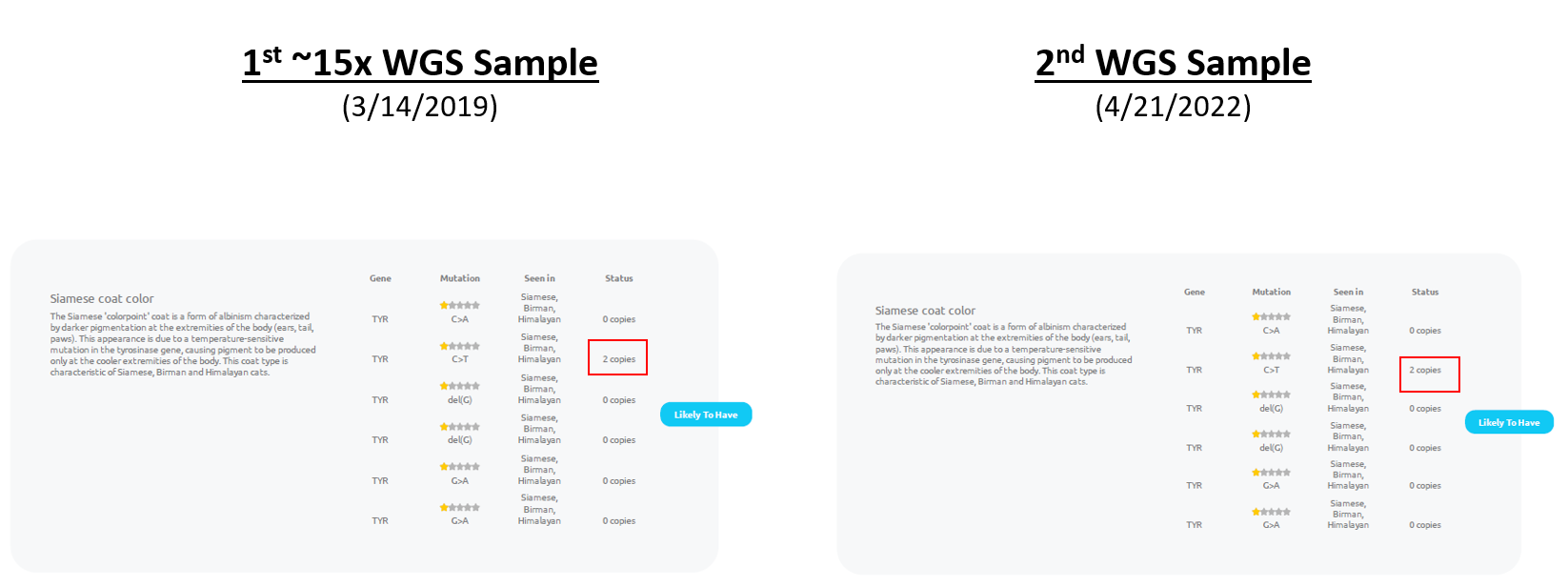
First, my cat was (incorrectly) listed has being likely to have the colorpoint trait in both reports:


As of 8/28/2022, the ability to tell that a report was more difficult than I expected because both sets of screenshots below are labeled as being version 4.0 reports:


Nevertheless, even if looking for the presence of the "black coat color result is not sufficient to tell if the "C>T" colorpoint variant has been corrected, I hope the content of this blog post can help you determine if a given v4.0 is likely to already have the correction or not.

I contacted Basepaws for the following reasons:

  • Even though you can have a Tortie Point cat, my cat does not have the colorpoint trait.
  • I have submitted samples to essentially all cat genomics organizations / companies that I was aware of.  While the markers could theoretically be different, the other results indicated that she has 0 copies of colorpoint mutations.  So, I wanted to check if the same variant was being tested.
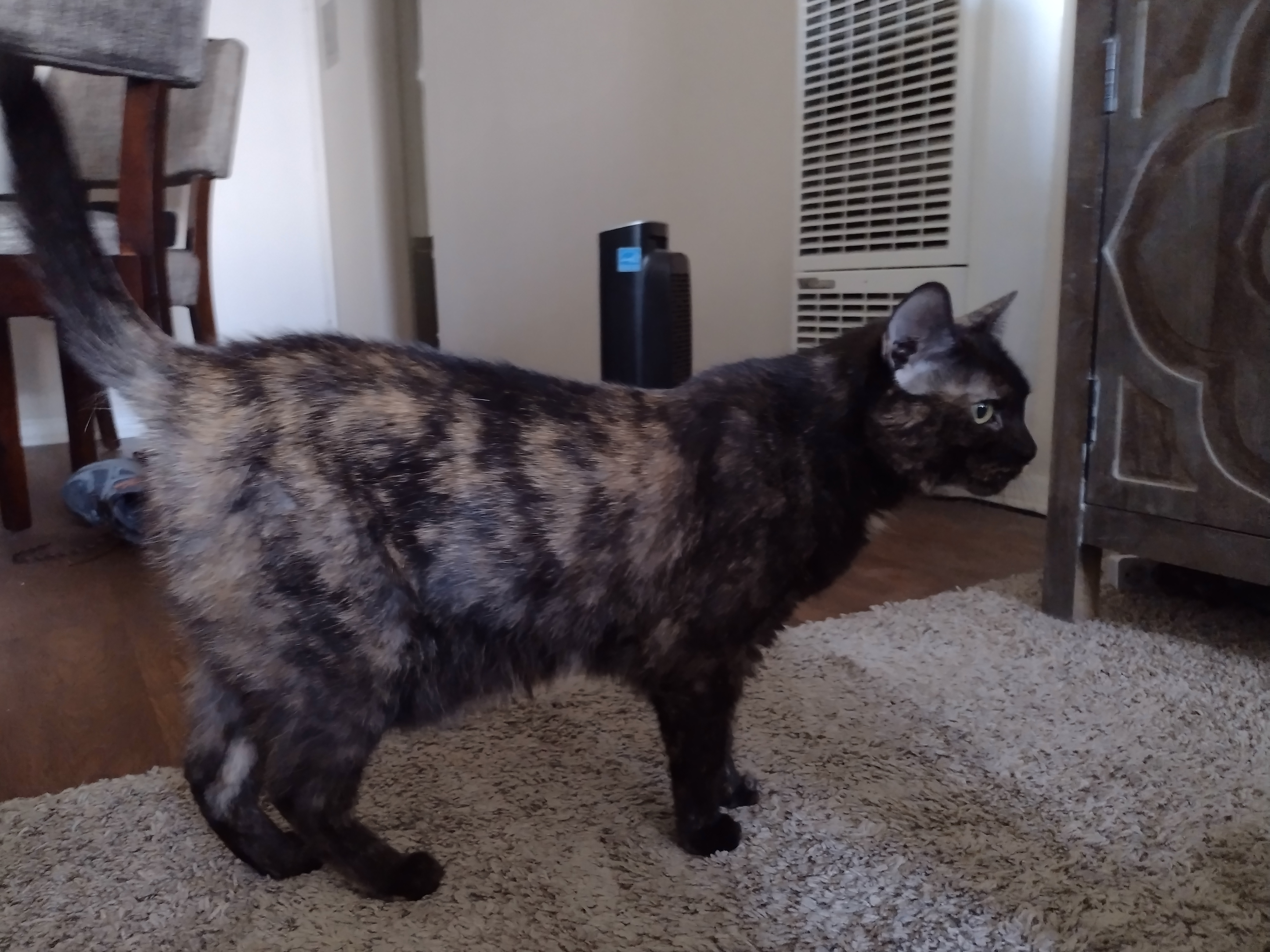
First, here is a photo of my cat (Bastu):


So, I think is reasonable to say she does not have the colorpoint trait.  There is also an additional illustration here (from this page) that I also think helps explain the colorpoint inheritance pattern.

There is also some discussion regarding traits in this Basepaws blog post, although I prefer the explanation for this page from UC-Davis (even though the result that I will show below are for the "Cat Ancestry" rather than the separate colorpoint test).

In terms of the UC-Davis VGL "Cat Ancestry" results for Bastu, you can see the trait marker results below:


The "C/C" result indicates that Bastu should neither have the colorpoint trait nor be a colorpoint carrier.

In terms of Wisdom Panel, you can see the results for some colorpoint markers below:


Bastu's Wisdom Panel results are split among multiple PDF exports of webpages.  However, the other traits that can be viewed in the same part of the interface can be seen here.

After discussion with Basepaws, my understanding is that the specific C>T mutation is a well-characterized variant, also called the "Siamese" colorpoint variant (with Basepaws staff passing along the Lyons et al. 2005 publication via e-mail).

There are some additional details from using raw data here, including selection of felCat9 chromosomal location to use.

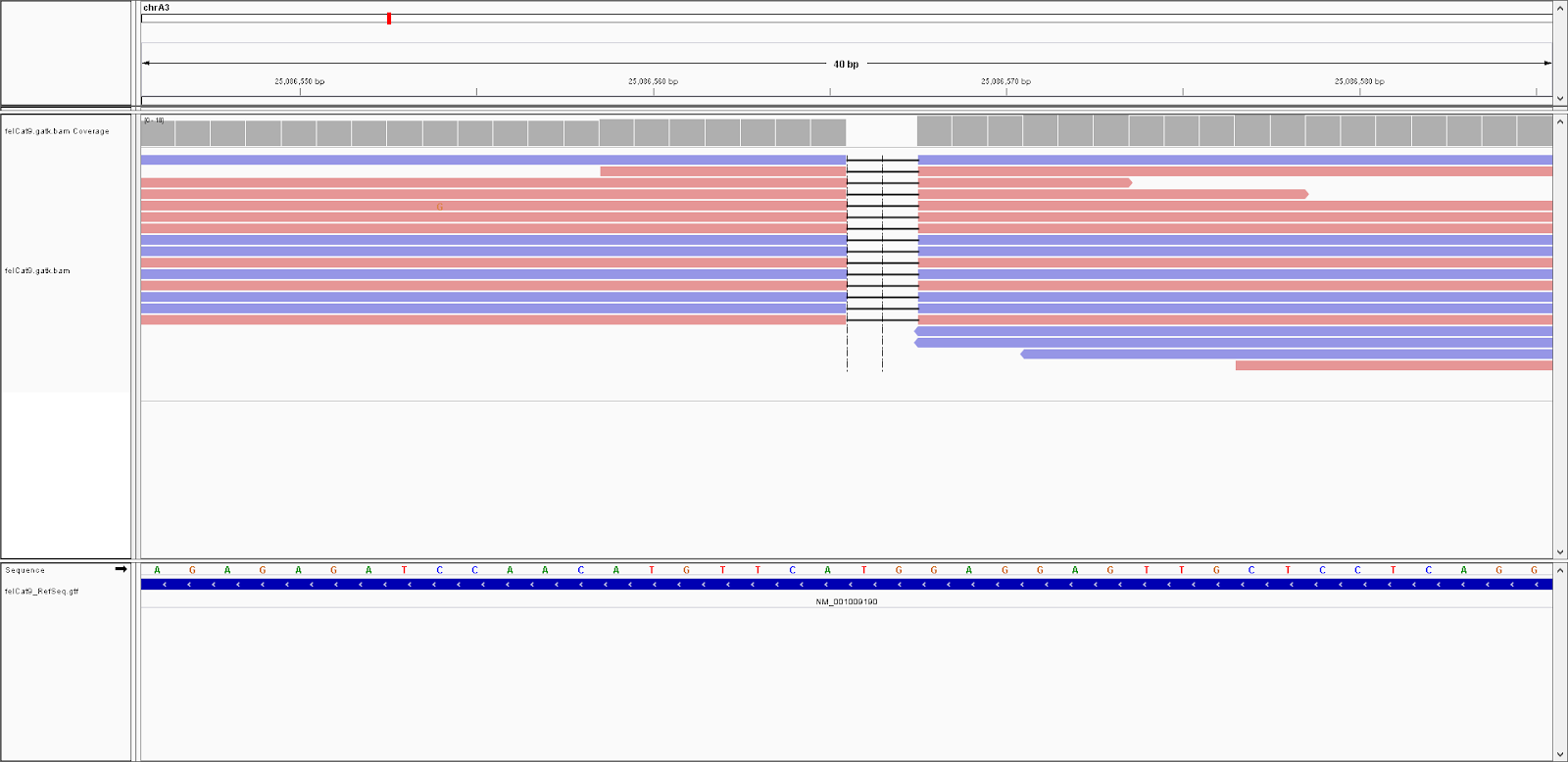
However, after those additional troubleshooting discussions, the alignment to the best matched region of the felCat9 reference genome (with data from my cat's first WGS sample) is shown below:


As a matter of personal preference, I think alignments similar to shown above most clearly show the lack of colorpoint variants (from this position).  However, you can also see that from the Amplicon-Seq data that was used for the report (even though these are Whole Genome Sequencing kits).  As a special exception, Basepaws provided a file that they also used to say the future reports should report 0 copies instead of 2 copies.

I have a version of that file imported into Excel with highlighted 100% sequence matches from the Amplicon-Seq data that I uploaded here.

I later realized that there is a 1 bp difference for the felCat9 for the amplicon (the "T" at the end should have been a "C").  The strand of the amplicon is the opposite of the reported nucleotide, but the felCat9 alignment is on the positive strand for the amplicon.  In contrast, the amplicon aligns on the negative strand with respect to felCat8, but the difference is still at the end of the amplicon (which appears at the beginning of the alignment).

So, now, using the raw data, you can tell that the results in future Basepaws reports will need to be changed to reflect that my cat has 0 copies (instead of 2 copies) of the Colorpoint mutation.  The lack of mutations now matches her fur color pattern!

Of course, if you also have discrepancies between results from different sources, then you should also contact everybody who is relevant.

If this is a health marker (instead of a trait marker) and you can confirm the cause of the discordance in either direction for the same variant (either a false positive or a false negative), then I would also recommend that yous end an e-mail to the Center for Veterinary Medicine at the FDA.  I believe that some technical knowledge is needed to upload data and it is most commonly used for human data, but I have confirmed that veterinary data for pets is allowed on precisionFDA.  Additional effort would be needed to configure an app for cat re-analysis, but all re-analysis of raw data is free through the precisionFDA interface.  So, some parts are arguably not ideal for the average consumer, but my point is that a framework to share such data exists and having access to raw Whole Genome Sequencing data was important for resolving the troubleshooting described above.

Health and Trait Variant Calls

(for current Whole Genome Sequencing Samples)

    In my opinion, I believe that the availability of raw data is a unique advantage to Basepaws (at least if you order the Whole Genome Sequencing kit).  The process of returning that raw data took some follow-up on my part, but I don't know how many customers intentionally order the kit to be able to receive raw data.  I also preferred the fastq.gz formatting for the 1st WGS sample over the 2nd WGS sample, but I am not sure if that might further change in the future.

    So, it was to my surprise, the Whole Genome Sequencing data was currently not being used to call the colorpoint variant for my cat.

    My understanding is that is also true for the other health and trait markers currently provided.   As far as I know, the Amplicon-Seq results are usually OK.  However, I hope that either changes or the use of different data types is more clear in the report (even for the "Whole Genome Sequencing" kit), because I was expecting variant calls from the Whole Genome Sequencing data.

    There was a problem with using the Amplicon-Seq data for the colorpoint mutation, but my understanding is that programming problems to interpret the raw data were a factor.

    Even though Basepaws went back and generated a new Amplicon-Seq library from leftover genomic DNA for my 1st sample (before the Trait markers were offered), I will not be provided the raw Amplicon-Seq data for either sample.  My understanding is that this is due to the multiplex design that could be determined from the FASTQ files.  I don't think this is ideal.  However, as long as the data types are not mixed in one library, I am OK as long as I do receive the raw WGS data.  Again, if anything, I would argue the Whole Genome Sequencing (WGS) data appears to be the preferable way to at least evaluate the C>T "Siamese" colorpoint mutation.

Ancestry Results

(uses Whole Genome Sequencing Data)

You can see the results from the 2 Whole Genome Sequencing samples below:

There are some differences, but I think this is starting to get relatively closer to the limitations of my human results.  For example, I think my cat mostly has no Exotic purebred relatives (and 1 of 2 reports for the same cat have a 0% Exotic estimate). 

However, you can definitely tell that the higher coverage data helps.

Here are earlier plots comparing the low coverage Whole Genome Sequencing (lcWGS) results to my 1st Whole Genome Sequencing result:

"Confident":

"Possible":


You can clearly see additional problems in the ancestry results for the less expensive kits, with much lower coverage data used to impute genotypes.

I am not sure how much the relative revision of genomic reference sequence for the cat versus human may also matter, but I would guess that might have some impact on making a fraction of the genotypes harder to impute (and, therefore, the ancestry harder to predict).

This also gives me the impression that the new reports may only be providing the "possible" results (without the option to view the "confident" results that I prefer).  However, I will follow-up with Basepaws on that.  Either way, I would say the higher coverage data helped, but I think that is most clear with the "possible" confidence results.

Nevertheless, even at whatever is used as the current setting, you can see my cat has mostly Western and Polycat ancestry.  That is consistent with what I see from other companies and organizations for the same cat.

Eukaryotic Metagenomic Results

(can vary over time)

You can see the results from the 2 Whole Genome Sequencing samples below:


I am not currently sure what to think about this.

Dental Health Scores

(can vary over time)

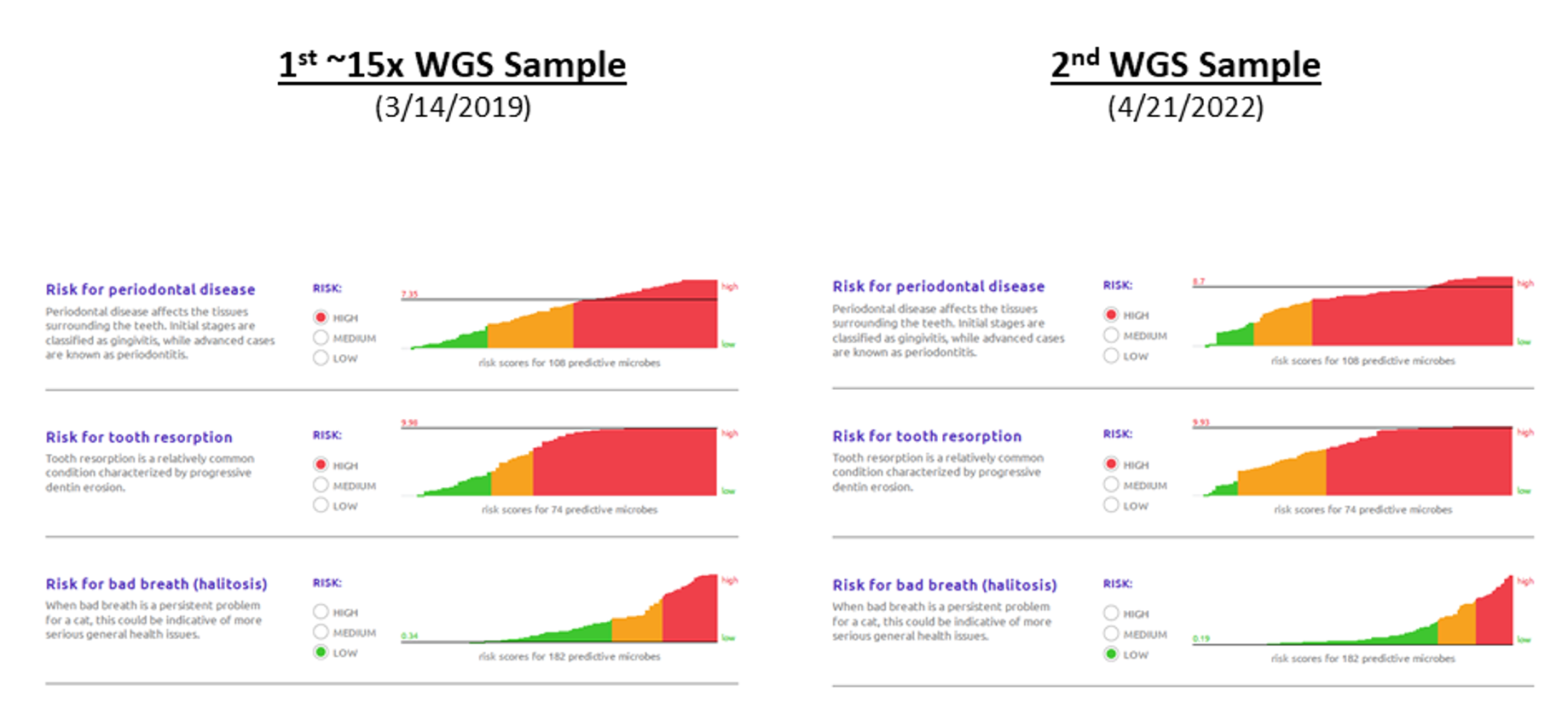
You can see the results from the 2 Whole Genome Sequencing samples below:


This is something that I hope that I can develop more of an opinion about over the next year or so.  For example, I have started a GitHub discussion where I list some things that I would like to look into and I certainly welcome additional feedback.

Similarly, I have already started a subfolder on this topic on GitHub that contains data/results and my thoughts so far.

One one hand, Basepaws has increased by general awareness of dental health in my cat.  For example, I have started discussions with my vet, and I think that is good.

However, I do not yet have a complete opinion regarding the Dental Health Test results.  For example, I would not actively recommend the Dental Health Test, but I am also not currently confident that there is a problem with the results that I can clearly explain.

Nevertheless, there are a few things that I would like to point out or comment about:

1) As I understand it, I think my cat has some of the highest "High Risk" scores that are plotted.  However, after multiple discussions with the vet, my understanding is that I should describe my cat as being in very good dental health for a cat her age.

My cat has been started on prescription dental diet, although my understanding is that is primarily a preventative measure given her age (and possibly my questions about dental health).  I will also take my cat in for the recommended yearly cleanings, and I believe that the vet confirmed that she doesn't currently need to come in more often.

Also, I believe that Basepaws has confirmed in an e-mail that the goal is to estimate risk and not to provide a diagnosis.  In other words, you can have a cat with a serious problem with low risk in the Basepaws Dental Health Test, and you can have a cat without a serious problem with high estimated risk.  My understanding is that cat falls in the second category.  The point is that something else needs to be performed by the vet to determine if your cat has a problem.

2) I saw an e-mail from 6/8/2022 titled "See what saved this kitty's life..." with a link to a blog post (which I believe was posted on 7/12/2021).

My initial reading and what I understood with  re-reading were different.  Because the test was collected considerably before any problems were observed, I think that is less of an concern.

However, what could have concerned me is if somebody noticed their cat had bad breath, ordered a Basepaws Dental Health Test, and then went to see the vet after receiving results from Basepaws 6 weeks later.

In other words, theoretically, I think this could have increased the risk of harm if there was an urgent problem.  The reason is that the Basepaws Dental Health Test can't tell you if your cat has a problem or not, and I would say you should start the process of trying to see your vet as soon as you notice a problem (not after waiting for a results that make take 6 weeks or more).  I could imagine a vet wanting to see if a symptom like bad breath persisted for some time before suggesting scheduling an appointment to bring the cat into the vet.  However, I would guess this waiting time might be more on the scale of days instead of more than a month?

For example, my understanding is the other cat was at "medium" risk in all 3 categories, which I would interpret as meaning the cat was at lower risk for than my cat (2 "high risk" scores and 1 "low risk" score for bad breath).  However, my cat had no serious dental health problems, and this cat with what I would consider to be at lower risk had a serious dental health problem.

I also had a question of "medium" risk versus "average" risk, but I have moved that to a footnote1.

So, I would at least consider bad breath a reason to call the vet and ask if the cat should come in.  I would not order a Basepaws Dental Health Test because my cat has bad breath (or any other novel symptom causing me concerns), and then wait for the results before scheduling an appointment with the vet.  I have also confirmed that Basepaws agrees you should not delay seeing your vet in order to obtain a Basepaws Dental Health Test result when you see a worrying symptom.

To be fair, I believe that I have seen at least one cat diagnosed to have a dental health problem with 3 "high risk" scores on the Facebook Basepaws Cat Club.  So, I hope that is helpful in getting an overall sense of the results.  However, I think the above examples are also important to take into consideration.

3) I think a well-characterized disease variant that has a second validation from the clinic could be different.  However, for the reasons above, I would have preferred that the Dental Health Risk scores were not added to my cat's medical record because of the discussion most immediately above.

However, I think the local vets have started to get to know my cat as an individual patient, so I would guess this is probably not an issue unless I had to see another vet (and that vet gave too much emphasis to those scores).

4) I remember previously reading about critiques from professors of veterinary medicine regarding the Basepaws Dental Health test in this Los Angeles Times article.  I have also added some comments on the preprint for the Basepaws Dental Health test, and I hope that others with relevant experience will do so as well (and I hope that there can be responses to comments from others).

However, again, I would certainly like to learn more!  You can either provide feedback as a comment, or there is a "discussion" enabled on the GitHub page.

Footnotes:

1When I asked about what represented "average" risk, Basepaws provided a link to the Dental Health Test whitepaper.  This is similar but not identical to the preprint.  So, I don't have a direct answer.  However, I can say that the preprint and the tables here were helpful in having discussions for my vet.

For example, I added an additional comment to the preprint regarding the positive predictive value estimation after talking to the vet.

The numbers in the whitepaper are slightly different (for example, there are 441 periodontal disease cats in the whitepaper and 570 periodontal disease cats in the preprint).  Nevertheless, if I use the preprint numbers, then I had possible estimates of positive predictive values for the combined high/medium group where I estimated the periodontal disease score might have positive predictive values of roughly 50% and the tooth resorption score might have positive predictive values of roughly 20%.

In every calculation that I attempt, the positive predictive value is noticeably lower for tooth resorption than periodontal disease.

For periodontal disease, I think the prevalence estimates and stage of the disease are important, but I wonder if might help to pose the question of whether something different than the standard recommended care should take place.  My current thought is to use the the vet's individual assessment (as independently from any estimate as possible) over the risk estimate, but I think conversations with your vet are worthwhile.  Basepaws clearly indicates the risk estimates should not be used as a diagnostic for dental health.

Change Log:
7/2/2022 - public post date.
7/3/2022 - add link to Dental Health Test GitHub discussion; also, as I went back to the possible confusion matrices that I created from the preprint to attempt to estimate the positive predictive value, I decided change wording for describing "medium" risk versus "average" risk as I look into the topic more; minor changes.
7/4/2022 - minor corrections; revise description of timing for other cat's dental health test.
7/7/2022 - update post after receiving e-mail response from Basepaws
7/10/2022 - add date to separate Basepaws e-mail from Basepaws blog post
7/16/2022 - formatting changes
7/17/2022 - after looking at 59 posted Dental Health Test reports, switch to only using the higher positive predictive value estimate.  The score distribution is different than the true prevalence, but that made me feel a little better about the possible positive predictive value.
7/20/2022 - minor changes + change footnote content
7/23/2022 - add additional UC-Davis VGL colorpoint link + minor formatting changes; add description of BLAT result with a minor difference from what I originally thought (mismatch at end, but not within BLAT hit); add link to product towards the beginning of the blog post.
7/24/2022 - re-arrange colorpoint background and provide photo of Bastu.
7/31/2022 - minor change to make Amplicon-Seq link earlier to find.
8/8/2022 - add link to Basepaws blog post acknowledging the fix.
8/14/2022 - add links to raw data for 2nd WGS sample (in format provided by Basepaws); update/modify section related to raw WGS data return and use of WGS data in reports.
8/16/2022 - formatting changes to make 2 hyperlinks easier to find.
8/23/2022 - upload alternative screenshot for Basepaws Siamese Coat Color result that is incorrect in the v4.0 report.
8/27/2022 - minor formatting changes
8/28/2022 - change tense for Basepaws correction, but also add content to explain how I have different v4.0 reports downloaded at different dates that are both before and after the "C>T" colorpoint variant correction; also, add links to reports that are downloaded more recently (with the corrected variant result).

Saturday, February 27, 2021

Why I think the basepaws "Breed Group" should be called an "Ancestry Cluster" (with abstract cluster names)

Part #1: Short Summary:

In the basepaws Facebook group, there are some noticeable issues with results for purebred cats that are not already part of the reference set (as I understand it).  To be fair, I have seen at least one report that was a good result (matching the known breed in a new test cat), but I think independent test datasets tend to be discordant with known purebred cats more often than they are concordant with new purebred cats (in the small fraction of customers where that can be tested).  Also, the majority of cats are mixed breed "Polycats" where there probably shouldn't be any close purebred relatives, and I think the results more-or-less match that expectation (if interpreted correctly, and I have found explaining precisely what I think is "correct" interpretation to be bit of a challenge).

Again, to be fair, basepaws does say "Disclaimer: The Basepaws Breed Index is not a breed test".  However, I think there is still some noticeable confusion.  So, regardless of whether my suggestion is helpful, I think it is safe to say you should not be using basepaws to confirm your cat's breed or disprove your cat's breed, and you may not have closely related cats for the "breed" with the highest estimated breed fraction in chromosome painting (which, in the wording of the current reports, may be "Breed Group" instead of "Breed Index" - either way, this is what you receive when you order the Breed + Health DNA Test, and you can see some type of chromosome painting in the various reports for Bastu).

After having several very helpful discussions, I thought of a possible suggestion that I thought might help: perhaps use a more abstract name for an ancestry group / cluster to make clear that you shouldn't use what is being provided to define breeds.

I think the best example may be the broad "Eastern" ancestry group, which is already in the reports (as a broader category) as well in previous literature on cat genomics.

If calculated accurately, I would expect Siamese cats will tend to have a higher estimate of Eastern contribution (at least for the "Traditional" Siamese cats, as I understand it).  However, I think the Colorpoint Restriction mutation might be what owners might want to check for cats with the characteristic hair color pattern.  For example, you might have to dig around a bit in the comments for this video but I believe "Lynx Point" cats can be defined from 2 markers (the Colorpoint Restriction variants, and Agouti variants for the tabby pattern).

Nevertheless, my point is that I believe giving the ancestry group the "Eastern" name adds a layer of conceptually separation than the "Siamese" (or related) breeds.

So, if technical problems are minimal, then I think this might reduce confusion for purebred cat owners (as well as minimize miscommunication from misunderstanding).  It might also reduce interest, but I would rather plan to have fewer customers than have more customers whose satisfaction might decrease over time.

It might also be worth noting that I believe most imputed genotypes are phenotypically neutral, meaning that they do not cause the traits that are used to define the breeds (although relatedness does define the breed, once it becomes established).

There are some additional details that I will discuss below, but I hope this can help for discussions (instead of me posting several comments, which may or may not be appreciated by all basepaws customers).  I also have a "Change Log" since I hope that I can update this based upon feedback, in order to try and be able to explain my point as precisely as possible.

Part #2: Intermediate-Level Details:

I have a separate blog post describing results (from multiple organizations / companies) for my cat Bastu.

However, I will copy / repeat some points below.  Some hopefully complement the main point for the "Short Summary," but some of these are separate points.

First, I think seeing 3 technical replicates for my 1 cat may be helpful in giving a sense of confidence in the results:

"Confident" Threshold


"Possible" Threshold


All 3 reports above were re-processed at the same time (for an update), but they were sequenced in different batches.

If you look at the broad ancestry groups, then there is some noticeable consistency with the technical replicates.  A mostly "Western" contribution for Bastu also makes sense, and that is also consistent with the her Ancestry Test from UC-Davis.

Please also note that the 1st 2 samples (left and middle) are low coverage Whole Genome Sequencing (lcWGS) and the report on the right is "regular" coverage sequencing (~15x).

For example, initiatively, I would not expect Bastu to be related to any Exotic breeds.  So, in addition to the general issue that accurately genotyped variation can exist before breed creation and confound the results, you can see the "Exotic" contributions go away in the higher/regular coverage sequencing data.

The main reason that I purchased the "Whole Genome Sequencing" kit was that I would get access to the raw data.  Since the price is different now, I will include the analysis part of this file below (without the header listing the original price):

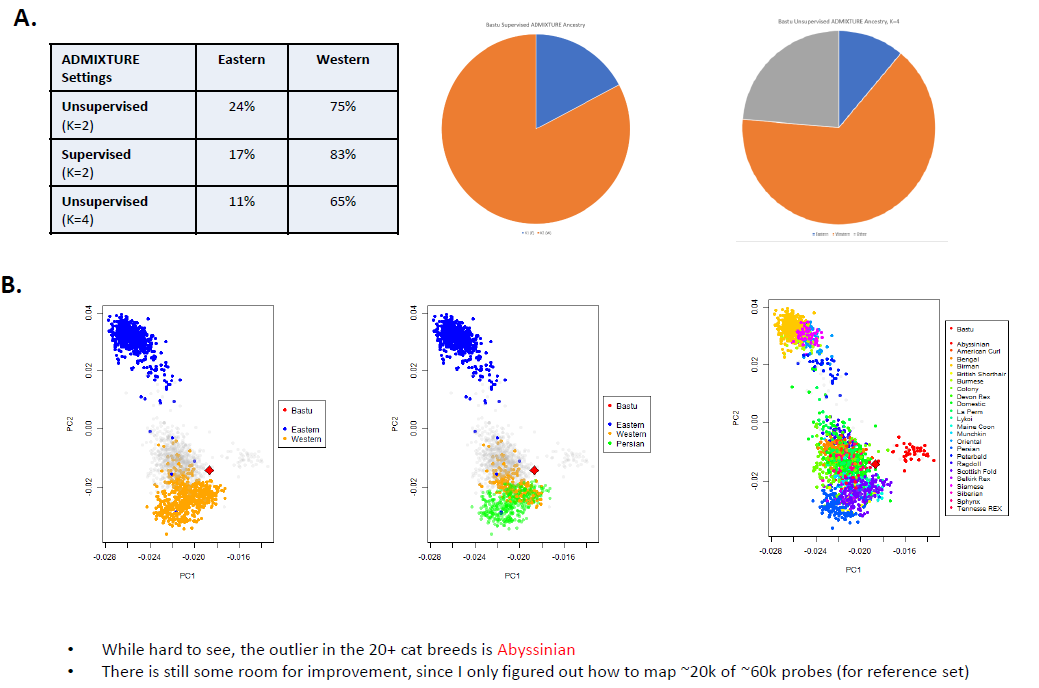
Again, noticed the relatively higher Western contribution is also consistent with my re-analysis.


While I want to make clear that the PCA plots (the dots in the bottom part of the image, which I tried to describe as part "B") come from a relatively limited number of SNPs (from public cat SNP chips).  So, I don't know what the spread looks like if you could look like if you could see the individual points in the basepaws data, but I think plotting a centroid may not be the best way to represent the data (if that is what was done here).

There has also been at least 1 sample mix-up (for a different customer).  However, basepaws offered a free re-test which showed much better results.  So, that can happen, but I am guessing that is rare (and the more common issue is what I am describing in this blog post).  For example, when you look at my 2 lcWGS replicates (equivalent to a paid re-test), one is not really better than the other.  There is just a certain about of noise and limits to the methods (at least currently).

Part #3: Advanced Details:

With my ~15x cat genome data (along with my human data), I tested running imputation of down-sampled reads, which you can see here.  I am also plotting that below:


For reference, I don't have the raw lcWGS FASTQ data, but earlier versions of reports said that technical replicate #1 had 3,488,515 fragments and technical replicate #2 had 2,712,098 fragments.  For comparison, my regular coverage WGS sample had 166,490,724 paired-end reads (I think comparable to the "fragments" in those reports).

Because of the fragments smaller than the read length, my "regular" coverage WGS was closer to 15x than 20x.  I also don't know how many fragments are for lcWGS versus Amplicon-Seq in the "Breed + Health" results.  Nevertheless, I think the lcWGS "fragments" in those earlier reports roughly match an expectation of being 0.1x to 0.5x.

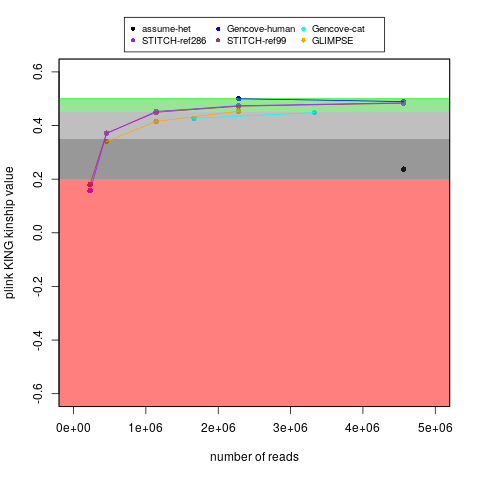
My main goal in the above plot was to test self identification.  With the same number of reads, the Gencove cat imputation worked a little worse for my cat's sample than my human sample (for either Gencove or open-source options for humans), but I don't think that is surprising because I think the human variation is better understood.  Nevertheless, if you follow the Gencove-cat trajectory, then I think there might be some benefits to having ~2x the fragment count (even though I would probably still not consider that to be equivalent to genotypes without imputation).  That said, to be fair, I don't know if some things (like broad ancestry groups) might be detectable with less precision than being able to self identify your own (cat's) sample.  Also, if a relative finder function is added, then Bastu's 2 lcWGS technical replicates can act as a positive control (to gauge how important this measure really was).

Likewise, I believe there is at least the Martin et al. 2021 paper emphasizing a noticeable advantage to using 4-6x WGS (over 0.5x WGS).  For example, there is a noticeable difference for the 0.5x results in Figure 4A (and as well as Table S4 and Table S5).  That is for certain populations, but it seems like that may match what I am seeing as well?

Perhaps most importantly, to give some more examples of selected problems on the human side, you can also see issues with the human lcWGS imputation here at the level of individual genotypes, which I think may be why Nebula now only provides regular/high coverage sequencing for customers.

basepaws uses Amplicon-Seq (not the lcWGS) for the health markers, so I believe those should be thought of as independent results (and the technical replicate discordance is not necessarily predictive of the concordance for the health markers).

My understanding is that basepaws is planning on adding Amplicon-Seq for trait markers in the future.  I think this will be added to the existing report for the "regular" coverage sequencing data.  However, customers will need to keep in mind this can't (or at least shouldn't) be added from the lcWGS.  My understanding is that the additional cost to add those extra Amplicon-Seq markers to previous reports will be minimal, but I think that is worth making clear new libraries need to be prepared to return those results.

It might not be the most important point, but I wanted to acknowledge that I believe what basepaws is doing with the chromosome painting is better than produced got for Bastu's sample with RFMix (which you can see here, for example, if you scroll towards the middle of the post).  However, I thought that was sufficiently far from being a reasonable result that I did not include that in my mini-report of re-analysis that I showed above.  I am also expressing similar concerns for the technical replicates above.

So, in the immediate future, I am not sure if doing something like the ADMIXTURE analysis used for the table and pie charts might help with giving robust results for those broad ancestry groups (which I think should also work with closely related cats, if you used something like plink kinship).  If there were any issued with defining relatedness with the chromosome painting results, then I think that that should be OK with enough reads for 1 genome-wide estimate (and I would rather have a close cat relative finder than a breed index/group that might cause confusion and may not be great at identifying breeds in new test samples, like what I have seen in the Facebook discussion group).  However, either way, that is the explanation for what I presented in my "mini-report" from re-analysis of raw "regular" coverage sequencing data.

Part #4: Acknowledgements:

I can't thank the other basepaws customers enough for their discussions, which have helped me sort through my thoughts.  I also hope that can continue in the future!

The basepaws staff has also provided responses to all of my e-mails.  For example, I think that is how I know the Breed Index/Group (which shouldn't be used to categorize purebred cats) comes from lcWGS and the health markers come from Amplicon-Seq (also verified here).  So, thank you for your helpful feedback, as well as encouraging a community were such discussion can take place!

P.S. I have some on-going notes about known traits (not currently in the basepaws report), but I would be happy to hear more.  This includes things like long hair.

In general, I tend to provide things like links to informational details from the UC-Davis VGL, but I am encouraging you to us the links on the informational page to purchase those separate tests.  For example, I purchased the UC-Davis "Cat Ancestry" panel that includes some trait markers as well the Optimal Selection panel (also mentioned in the earlier blog post).

If you are a breeder, I think part of the goal of Optimal Selection is to identify mating pairs with the maximal possible diversity within the breed.

Maybe it is otherwise a little off-topic, but I mention this because I think people purchasing the Breed + Health kit might in fact be interested in understanding some of the traits that they see in thier cat.

P.P.S. If a relative finder was added and both parents were in the basepaws database, then that would in fact be relevant for confirming that a cat is purebred (as long as there were no methodological issues, or especially low read coverage).  However, that is not currently offered from basepaws, so that is why I am saying that the current breed measures cannot be used to determine your cat's breed (as also said in the disclaimer from basepaws).

Change Log:

2/27/2021 - public post

2/28/2021 - minor changes (including switching wording from "Breed Index" to "Breed Group")

3/6/2021 - add notes for some other common questions and caveats + minor change

3/15/2021 - add lcWGS fragment counts (and linked image)

3/26/2021 - add note to make clear that all 3 reports were re-processed at the same time + add link to Martin et al. 2021 lcWGS paper

3/28/2021 - add extra details / minor re-organization; correct misunderstanding of table

4/18/2021 - add sentence about basepaws sample mix-up

11/21/2021 - add note about 2 markers defining "Lynx Point".

Wednesday, December 18, 2019

Review of Results / Data from 3 Cat DNA Organizations / Companies

NOTE: If this post is too wordy and/or contains too many details for a broader audience, then I would recommend viewing this YouTube video (from somebody else, with a different cat).  However, those comparisons do not consider the UC-Davis VGL (Veterinary Genetics Laboratory) report or the Whole Genome Sequencing results (from Basepaws).  So, if you might be interested in information for those other options, then I hope this blog post may be useful!  Nevertheless, I think some main messages are similar with an independent assessment.

Back in 2012/2013, I checked out the UC-Davis VGL Cat Ancestry test for Stormy the Scottish Fold (which I described in this blog post).

However, Stormy is not my cat.  So, I decided to test my cat (Bastu) for a few different options out there for the general public.  While more recently expanded, this started from notes that you can see on this GitHub page (including subfolders for most of the raw basepaws analysis).  I am also continuing to upload updated basepaws reports there.


UC-Davis VGL (Cat Ancestry, $120)

  • You can see Bastu's VGL report here
  • I would recommend visiting the VGL cat website to learn more about the genetic tests (often used across companies).
  • I also like that trait information is provided for specific variants, most directly related to the phenotypes of interest.
  • So, I think "Cat Ancestry" is a nice brief report, which also includes checking for some mutations associated with traits (sometimes for a trait defining a breed).
  • Saliva sample collected with cytobrushes.
  • In terms of ancestry, I think these tend to be the most robust results in terms of "Eastern" versus "Western" ancestry (some people on the basepaws discussion forum didn't initially like them because lack of detail, but I believe some of the more "interesting" results may be less robust and/or are commonly misunderstood).
  • At least when I ordered the kit, I think this option has the longest turn-around time (I noted that the last kit had a turn-around time of a little more than 3 months).
Also, if you didn't click the PDF link above, here is a screenshot of the main part of that report:


basepaws lcWGS + Amplicon-Seq (regular price $149)

  • The more recent reports are interactive (where I "printed" a PDF to download), and you might want to download the files (selecting the green "Code" button and then "Download ZIP") from GitHub link to view the full names for all of those files.
    • Nevertheless, you can see various versions of Bastu's reports here.
  • For either sample type, I liked the basepaws Facebook discussion group (Basepaws Cat Club), to become part of a community with other cat lovers.
    • The text related to reports to the reports can often make me feel uneasy, and I have been working on resisting commenting about that as often (since I don't want to say nothing at any point, but I also don't want to harass the other customers).
    • However, posts that focus on seeing other people's cats is something nice that is helpful in making my day a little better.
  • I also like the vibe of the company, in terms of having a blog and fun merchandise
    • For example, I purchased a Whiskers Face Mask for myself (but please note I had an extra $4 for shipping, and I didn't initially notice that it said "basepaws" in small font).  I have some face masks, but I thought this looked extra fun!
  • Sample previously collected with material like packing tape (for hair), but more recent sample collected with foam swab with preservation material (for saliva)
    • The foam swab is supposed to be inserted into the cat's mouth for 5 seconds
  • This may change in the future, but I also have some concerns about the representation of the company and timing/expansion of company offering.  I would no longer have concerns if this was changed, but there are multiple examples of this:
    • As one example, at least currently, I think they need to add the word "consumer" to their CatKit box (for example, the VGL results were clearly available earlier).  However, if this is changed, then I no longer have this concern.
      • On the plus side, I believe the need to do this has been acknowledged.  However, I think it has still not been added the to the box for the kits.
      • To be clear, I think pretty much everything in this post would benefit from continual evaluation/verification, and drawing similar conclusions from independent data/experiments is important.  
      • So, the point is not to emphasize whomever is "first" so much as not being able to say that you were first (and there being evidence against making this specific claim).
    •  As another example, under "About Basepaws," the Cat Behavior Summit website says "Basepaws is a leader in feline health, providing world's first at-home genetics and biome testing with digital results available in weeks."  Again, basepaws did not offer the first at-home genetics testing for cats.  Additionally, there are currently no biome testing results in the report (at the time that information was posted - I do currently have a metagenomics report for my regular coverage sequencing data).
      • It is possible to do microbiome/metagenomic analysis with low coverage Whole Genome Sequencing (lcWGS) results,  but I do not believe it is accurate to say this in the present tense.
        • I have been notified as a plan for basepaws to add a dental health test. I did see a similar number (50-90%) reported on this page for cats, and an estimate of 77% on this page would also be overlapping (for the broad category).
        • Again, for any level of severity, if you count 50-70% as being similar, then that overlaps what is reported here and perhaps pages 10-11 of this report.
        • However, I think the claim about prevalence looks different than I see in this paper on dogs. Likewise, I can also see this paper where the prevalence is more similar to what I saw in cats (10-15% for periodontal disease, which was in fact reported as being the most common specific disease)
        • Possibly somewhere in between, in this paper, there was a fraction of overall "dental" problems being reported in the abstract is ~30%.
        • I don't see dental problems listed on this ASPCA page, (or, I believe, this Wikipedia page).  So, I am not sure what to think about that.
        • I will continue to gradually look into this more, but the "periodontal disease stage" for dogs (and stage I, for cats) in the 2016 VCA report earlier (with a higher percentage for "dental tartar") seems like what I was expecting (with values <10% for stage I cats, and varying fractions by age for dog that are also all <10%).
        • Though this video, I have also learned about things like VOHC.
      • That said, if the raw data was provided for all kits, then I would be OK with those having enough familiarity/background to use open-source software can test different ways of looking at the data (with an understanding that you may not be able to make any confident claims about the interpretation of those results, and the customer base for that is probably more limited).
    • I also have some more specific scientific/technical concerns about the ancestry / breed results below.  So, I would say that there are still noticeable issues with what is currently being provided, before expanding into something more noticeably different.
    • That said, to be fair, and I have similar notes on human genomics companies (as well as discussions on the science-wide error rate with personal experiences and corrections / retractions on other papers).  So, I hope that shared experiences about past mistakes can help each of us learn the best way that we can help make the world a better place.
      • I myself am trying to figure how how to work on fewer projects in fewer depth that are ideally of good quality.  So, I think it is possible that a limit on the total number of commitments might be relevant on any time frame.
      • I think it is usually hard to be too nice, and I think compassion is important for managing your own stress as well as others. However, if these things were being done intentionally, then I think I should say that is somewhat different.  Either way, I also think paths to redemption need to be available to everybody.
  • I very much like that the likelihood of future changes in the report is often repeated basepaws, but there are some parts of the report that I have concerns about.
    • For example, I think the idea of hybrid breeds (like the Savannah) is genuinely interesting, but I think giving percentiles for the wild cat index to large cats (like tigers and cheetahs) is frequently giving consumers the wrong impression in terms of the biological significance of a result (and that percentiles can be defined for a completely random value, like a null distribution).
      • To further emphasize that the wildcat percentiles don't reflect absolute differences, you can see a phylogenetic tree from Wikipedia here.  For example, you can see all domestic cats should be more closely related to a cougar or a cheetah than a tiger or a leopard.  So, if your cat has tiger ranked first, then that doesn't mean that your cat is most closely related to tiger than the other 3 wildcats.
      • To be fair, the report does say "[these] results should NOT be interpreted as evidence that your cat is part wildcat".
    • I also have concerns with the specific breed index.
      • For example, I think the Savannah also provides a good example of my concerns with the domestic cat breed index (where the majority of customers with Savannah as their top breed probably don't have cats that descend from Savannah cats), and you can see some notes about that here.
      • I am also going to show you below how much this varies for technical replicates for my 1 cat.
      • In general, I think the Facebook discussion group has done a good job of providing examples of false positives and false negatives for using the breed index to define breeds.  
      • However, to be fair, there is a warning that "[the] Basepaws Breed Index is not a breed test, and can not tell exactly what breed your cat is.".
      • I also have a lengthier explanation on this specific point in a newer blog post, but I think a lot of the individual points are also mentioned in this post.
    • Also, as I mention in the Facebook discussion group, you can see some things that worked well for my human lcWGS data and some things that were unacceptable for my human lcWGS data.  I am also assuming that human variation is better understood than cat variation, which might relate to some of what I am about to show.  However, even for people, my country-specific AncestryDNA predictions of ~20% have confidence intervals that go down to 0%.
      • I think this is somewhat good in that it shows they understand the need to have the Amplicon-Seq for specific mutations (if using lcWGS).
      • However, if it was me, I would only provide Eastern-Western ancestry estimates and the relative finder functions (without providing genome-wide distances to purebred cats of unknown total number from reference set).

I also ordered a second lcWGS + Amplicon-Seq kit from basepaws for Bastu.  The mutation results and broad ancestry results were similar, but you can see differences in the exact values and top percentiles among technical replicates:


You can also see this report, which I submitted to FDA MedWatch.  However, please note that I do not believe that this was the right system for reporting for veterinary applications*.  I am following up to learn more, but I believe that you are supposed to fill out the PDF from this page and e-mail that to CVM1932a@fda.hhs.gov.  I think you may need to download the PDF, since it did not render correctly when viewed through my web browser.

To be fair, I wanted to compare the technical replicates compared at the same time.  While I think there are some noticeable improvements (such as providing a scale to switch to confident results and I think the percentiles have been removed), I think the point about the breeds might be even more clear:


You can see the top specific breed often changes.  I think some things are helped by switching to the confident assignments, even though that wasn't perfect.  I think seeing the top exotic result change between the confidence levels might help illustrate what I was saying about the problem with those assignments (such as the very rare Savannah):


I think there is still an issue with the chromosome painting (with the earlier problem explained below the footnotes), but it is the same issue that I encountered when I tried to run the analysis with public SNP chip data (which you can see at the middle of this post, for example).

In general, it seems like the broad ancestry groups are more robust than the specific breeds.  However, I thought it might be interesting that Maine Coon was the top Western breed if the confident results are selected (which might have matched the PCA plots that I showed above).  That said, you can hover / click the specific breeds to see the chromosomes for each breed.  So, the only specific chromosome that is common between the 2 technical replicates was chrB4.  However, Bastu is a carrier for the M3 long-hair marker, which is on chrB1.  So, these particular reports are not providing evidence that you can identify a segment that is similar to Maine Coon basepaws customers that includes Bastu's 1 copy (out of the needed 2 mutated FGF5 genes to cause long hair) of the M3 mutation in the FGF5 gene.  Plus, this is not true for my 15x sequencing report (Russian Blue is above Maine Coon).

Again, to be fair, basepaws makes clear that you should expect reports to be updated.  So, as long as you realize this (and don't take any action based upon the lcWGS results), I think this should be OK.  

That said, the relatively greater contribution of "Western" ancestry was robust (with the UC-Davis results and my custom re-analysis of the raw higher coverage basepaws WGS data).  For example, with an earlier report, if you sum the "Western" (39.2%) and "Persian" (12.4%) contributions from basepaws (51.6% broader "Western"), that is similar to the K=4 ADMIXTURE analysis that I performed on Bastu's higher coverage data (65% Western ancestry).  I believe a 10-15% difference in ancestry estimates is relatively similar (and the conclusions are qualitatively the same).

I also had concerns about the use of percentiles, but I don't believe this is in the most recent reports.  However, this may be conceptually useful for discussions about things like Polygenic Risk Scores, so I moved that content below the footnotes.

Similarly, I also moved down the content related to the earlier smaller segments below the footnotes (which had a different problem).


basepaws ~15x WGS (regular price $599)

  • I think this was supposed to be closer to ~20x, but please note that small fragments decrease the actual genomic coverage
  • There are links to download Bastu's raw FASTQ data from the GitHub page
  • This is my recommendation for getting raw data (for re-analysis)
    • I think you might technically be able to do with with a large enough donation to the 99 Lives project (not related to basepaws), but I think that is probably more about funding research than having a cost-effective way to get sequencing data.
    • If you were able to do sequencing on a lower-throughput machine through a DIYbio group, I think that would probably end up being more expensive.  However, I think that should be viewed more for training / education, rather than just getting raw data genomic data for your cat.
  • There was a fairly long time when I didn't have a report for this sample.  However, I more recently noticed that I can now download 3 reports, so I believe the report for my earliest sample was for the this higher coverage sequencing (as of 10/16/2020, you can view the PDF for "possible" results here and "confident" results here).
    • While I expect the individual variants / genotypes to be more accurate, I think there is still some room for improvement in the ancestry results (as I currently describe above for the lcWGS + Amplicon-Seq).
    • For example, it might be good that there is only "Western" and "Polycat" ancestry at the "confident" setting.  However, there are still some noticeable differences between my technical replicates in the last section (which I believe were the same on 10/16/2020, compared to the screenshots for an update for this blog post), including a change in the top breed (which expected was probably less robust / accurate).  Nevertheless, I think that the fact that the largest percentage (not on top)  was "Broadly Western" was a good sign.
    • In terms of the timing, my guess is that new customers probably won't have to wait as long to get the report (which I hope is updated as frequently as the others).
    • As a summary, I am showing some views of the 3 official basepaws reports below:

"Possible" Setting for basepaws ancestry report:


"Confident" Setting for basepaws ancestry report:


To be clear, all results that I  will now show below are custom analysis of raw data (and should not be expected for other basepaws customers).  For example, you can see a custom report that I created for Bastu here.  However, please note that the cost used to be higher, so I am listing what I paid (not the current price, which I have tried to update in the blog post).

For the custom re-analysis, one thing that I think is kind of neat is the separation that you can see between Eastern and Western reference samples (even with a relatively small number of probes on the cat SNP chip):


Even if there can be some improvement for the specific species, there is already some noticeable overlap if you try to separate the Persians from the Western cats.  However, what I thought might be possibly interesting is that Bastu was arguably slightly closer to the Maine Coon (and the UC-Davis VGL Cat Ancestry showed that she was an M3 carrier, which believe was found in a decent proportion of Maine Coons):


In terms of testing Bastu's mutations from UC-Davis, 2 out of the 3 showed reasonable validation:

Agouti (ASIP, a/a)


Long Hair (M3/N, FGF5)


I saw one read including the 3rd variant, although I am not sure why it was at so low frequency.  At least currently, I don't feel the strong desire to see if I can get something closer to 50% frequency with more starting DNA, but I can leave this as something to ponder for the future (and note that the UC-Davis VGL and Optimal Selection samples were also saliva samples patiently collected from Bastu's cat mouth, although the mechanism was slightly different).  Either way, her heterozygous status was validated on the 5th page of the Optimal Selection report (the 2nd page of the "Trait" section), so I believe this is her true genotype (and it's also possible the read ratio may improve with higher coverage).

Dilute (D/d, MLPH)


Optimal Selection / Wisdom Panel Feline (currently $99.99)


  • As I mention in my GitHub notes, the company name was a little confusing.
    • I also see "Mars" on a lot of the content provided through Optimal Selection, but perhaps this article about Optimal Selection for Dogs can give some extra context?
    • More recently, I noticed that I could only download a legacy PDF.  So, this might still be important, I moved my earlier screenshot below the footnotes.
  • You can see Bastu's report in PDF format here
    • At 2 weeks, this report has the fastest turnaround time
    • I also believe this provided the largest list of specific mutations (for traits and diseases)
  • I think it may be worth mentioning that the current (?) name of the company relates to selecting purebred cats for breeding.
    • In other words, I think the basis of this company is to essentially find the most genetically different cats among those that have the specific traits to define the breed (and/or are registered as a purebred cat) 
    • Even if you can get a little tighter clustering of specific breeds than I showed in the PCA plot above, I think this is somewhat more of an indication that the genome-wide similarities may be better for defining distance (which could be for breeding endangered species, etc.) rather than trying to say "what your pet is made of" for ancestry.
      • In other words, even though basepaws indicates they are not a breed test, I worry that those genome-wide distances to breeds described above can cause confusion / misunderstanding for customers.
  • I also learned about some additional mutations that I don't believe are currently on the public Davis VGL website for cats.
    • While I think they are currently disabled, I could learn some information from the Optimal Seletion help menu (available to those with accounts).
    • I think a lot of these come from OMIA (which sounds like OMIM, but I am not aware of an NCBI version of OMIA, unlike OMIM)
  • Saliva sample collected with cytobrush (2x, 15 seconds each)
  • They currently do not provide raw data (as confirmed via e-mail)
    • I also don't believe there is anything about Eastern-Western ancestry (and no raw data for potential re-analysis).  This probably isn't crucial for most customers, but this would mean you would may want to consider UC-Davis and/or basepaws if you were interested in that (or wait and see if that gets added in the future - I did suggest creating a PCA plot like I show above for the basepaws higher coverage WGS data, and I think they are considering that).
  • So, unless you value raw data (such as with the basepaws $950 WGS FASTQ+BAM+VCF) and/or supporting a non-profit (as with the UC-Davis VGL), this is what I would recommend for ~$100
    • That said, I am interested in learning more about cat genetics / genomics.  So, I will still make all 4 purchases, even if I had the option to go back in time and make the decision again.


Overall:

Briefly, I would say I have concerns about the ancestry results and how basepaws represents themselves sometimes.  However, if you want raw data, I think basepaws provides the best option for that (if you may more for higher coverage sequencing).

I personally like supporting a non-profit like UC-Davis, and I think the information that they provide should be used by everybody.

I am not entirely certain what is happening with Optimal Selection / Wisdom Panel.  If you can't purchase that kit, then UC-Davis (and custom re-analysis of raw data) may currently be the only way to check for specific trait mutations in the "Cat Ancestry" test (until basepaws adds those later on).

Finally, since I have been asked by others, I think "Bastu" does mean something (not related to cats), but I was Googling names for cats and that somehow popped up.  I like it because it sounds like "Bast 2" (like Bastet, the Egyptian God) and "Babou" (Salvador Dali's pet Ocelot**, referenced on the TV show Archer).


Footnotes:

*You can report adverse events for veterinary products to the FDA.  However, my understanding is that pre-market approval is not needed before a product is made available.

**To be clear, I am not recommending anybody get an Ocelot as a pet.  I just like Ocelots.

Problem with Earlier Smaller Segments (basepaws):


The issue with the above image is that I would have expected more variation in ancestry between the two copies of chromosomes.

They aren't 100% identical, but it seems odd to me to have matching ancestry / variants at the same position in both chromosome copies (scattered on several chromosomes), particularly for presumably rare events like "Exotic" ancestry estimates (if truly unique for a breed).  For example, you can see some notes on visual inspection and critical assessment of chromosome painting here (and the concept may be easier to see for my human data).

Earlier Percentile Concerns (basepaws):

I think Bastu may also provide a good example of why you may not want to use the percentile rankings in the basepaws results:


When you view the segments, there is more genome-wide predictions with the Maine Coon (and I think that may also be a better match for her M3 long-haired variant and the custom re-analysis that I performed), even though the percentile was lower than the Norwegian Forest Cat.  On the other hand, this may mean others are more likely to have false positives for Maine Coon ancestry segments?

Screenshot for Earlier Interface (Optimal Selection / Wisdom Panel):


There used to be a  "public" list of cats and their results (after you have ordered a kit, I think you could use this link).  For example, you could see what purebred cat reports look like this way.  Likewise, I made Bastu's result public, and you could view that here (completely public, without requiring a sign-in).

I don't currently see this feature.  However, I hope that it is added back in.


Change Log:

12/18/2019 - public post
12/21/2019 - minor updates
12/28/2019 - revise content for clarity
1/8/2020 - add a couple more screenshots; update Bastu's report to include Amplicon-Seq disease variants
1/9/2020 - mention longer turn-around time for UC-Davis VGL; remove holiday prices for basepaws
5/8/2020 - add technical replicate results
7/6/2020 - add link to notes on especially large concerns about Savannah Exotic breed index
8/14/2020 - minor changes + remove earlier note about delay in Amplicon-Seq mutation results
8/29/2020 - add draft for submitted FDA MedWatch report
9/3/2020 - add updated technical replicates and summary
9/7/2020 - add updated technical replicates and summary
9/11/2020 - correct confident technical replicate labels and add basepaws Maine Coon maps
9/15/2020 - add Ocelot note / warning
10/6/2020 - add concern about basepaws "biome testing"
10/7/2020 - minor changes / fix typos
10/16/2020 - add regular WGS report (reorganize post now that I have 3 reports); update/check prices for all 4 options
10/17/2020 - give date instead of time for introduction (since the original post was about a year ago); minor changes + revise content to make more clear (and move points that are currently less relevant below the footnotes).
2/20/2021 - update some basepaws notes, clarifying my opinion and adding examples for metagenomic application
2/21/2021 - minor changes + substantial extra information for dental disease
2/22/2021 - minor changes + additional disease prevalence link
2/26/2021 - add link to acknowledge need to say "consumer"
2/27/2021 - add link to VOHC
3/4/2021 - add link to FDA veterinary adverse event reporting
3/5/2021 - add link with FDA veterinary limits
3/14/2021 - add link to newer blog post
7/19/2021 - update link / posts
4/16/2023 - add link to alternative, independent YouTube assessment; formatting change when describing earlier format for Optimal Selection results.
 
Creative Commons License
Charles Warden's Science Blog by Charles Warden is licensed under a Creative Commons Attribution-NonCommercial-NoDerivs 3.0 United States License.